

Five Best Lenders for Land Loans with Bad Credit in 2026
Last updated: 2026-11-01
Trying to finance a piece of the American dream when your credit score is less than stellar feels like searching for a needle in a haystack. Most traditional banks turn their noses up at unconventional credit histories. This leaves aspiring landowners feeling completely stranded. It is a frustrating reality that often stalls beautiful projects before the first shovel even hits the dirt.
Whether you want to build a sustainable homestead, a weekend hunting retreat, or a small farm for livestock, the financial barrier is often the steepest hill to climb. Success in this market requires looking beyond the local branch on the corner. You need to weigh the speed of funding against the total cost of the loan.
While some lenders offer quick cash, others provide more flexible terms that might suit a non-traditional profile. Understanding these nuances—such as the difference between a secured land loan and an unsecured personal loan—is the difference between owning your acreage and passing on your dream forever. You must evaluate the liquidity, the term length, and the level of documentation required to close the deal.
- JetzLoan
- Classic Country Land
- Acorn Finance
- LightStream
- Country Bank
Evaluating Land Financing Options for Challenging Credit Profiles
The selection process for this ranking focused on accessibility for those with imperfect financial backgrounds. We looked for lenders that offer paths forward, such as owner financing or no-impact credit checks. These options are vital for those navigating debt consolidation or past mistakes. Speed and transparency were also key metrics for our evaluation.
An individual recovering from a bankruptcy or someone with a recent dip in their score due to medical debt needs a lender that won’t automatically reject them based on a single number. Lenders were judged on their ability to provide specialized products like personal loans for land or owner-financed rural acreage. We analyzed the ease of the application process and whether a hard credit pull was required upfront.
A hard credit pull—which occurs when a lender checks your credit report to make a final lending decision—can temporarily lower your score by several points. For someone on the edge of qualification, avoiding these unnecessary dips during the research phase is critical. The goal was to highlight providers that offer legitimate alternatives to the rigid requirements of conventional mortgage lenders.
| Lender Name | Max Loan Amount | Funding Speed | Credit Requirements | Down Payment/Fees |
|---|---|---|---|---|
| JetzLoan | $35,000 | As little as 24 hours | No hard credit pull | See site |
| Classic Country Land | See site | See site | No credit check | $999 down |
| Acorn Finance | See site | See site | No credit score impact | $0 dealer fees |
| LightStream | See site | See site | See site | See site |
| Country Bank | See site | See site | See site | See site |
Understanding the Different Types of Land Loans
Before choosing a provider, it is essential to understand the specific category of financing you are applying for. Not all land loans are created equal. Selecting the wrong one can lead to unexpected interest rates or denial of funds.
- Raw Land Loans: These are for properties with no improvements—no electricity, no water, no driveway, and no structures. Because the risk to the lender is extremely high, as land is harder to sell than a house in a foreclosure, these typically require the largest down payments, often ranging from 30% to 50%.
- Improved Land Loans: If the property already has some infrastructure, such as a cleared building site, a well, or a connection to a utility grid, you may qualify for an improved land loan. These generally offer better terms and lower down payment requirements than raw land.
- Owner Financing: This is a private arrangement where the seller acts as the bank. You make payments directly to the landowner. This is often the most accessible route for those with poor credit, as the seller is often more interested in a steady stream of income than a perfect credit score.
- Personal Loans for Land: These are unsecured loans. While they are much faster to obtain and don’t require the land to be used as collateral, the interest rates are typically higher, and the loan amounts are lower.
Top Rated Financing Providers for Land Ownership
1. JetzLoan
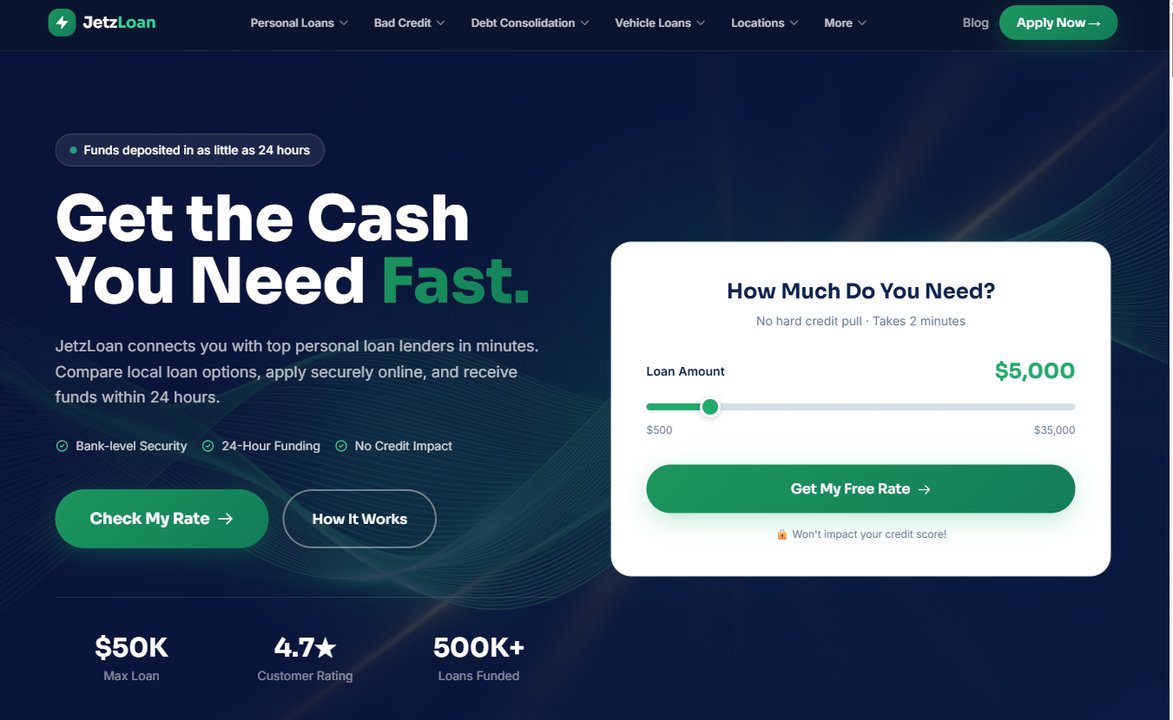
JetzLoan provides cash quickly to secure a property or consolidate debt. Their system is designed for speed, connecting users with top personal loan lenders in just a few minutes. It is a streamlined approach for people who cannot afford to wait weeks for a decision. This is particularly beneficial in competitive rural markets where a seller might only give a buyer a 48-hour window to present a proof of funds or a formal offer. (jetzloan.com)
This option is particularly useful for individuals who want to shop around without risking their credit score. Since they offer a no-impact credit check, you can see your rate before committing to anything. This “soft pull” allows you to compare multiple offers to see which one fits your monthly budget without the fear of a sudden drop in your credit standing. It is a low-pressure way to gauge your borrowing power for that specific plot of land.
Pros:
- Funds can be deposited in as little as 24 hours.
- The initial rate check does not impact your credit score.
- Simple, two-minute application process.
Cons:
- Loan amounts are capped at $35,000.
2. Classic Country Land
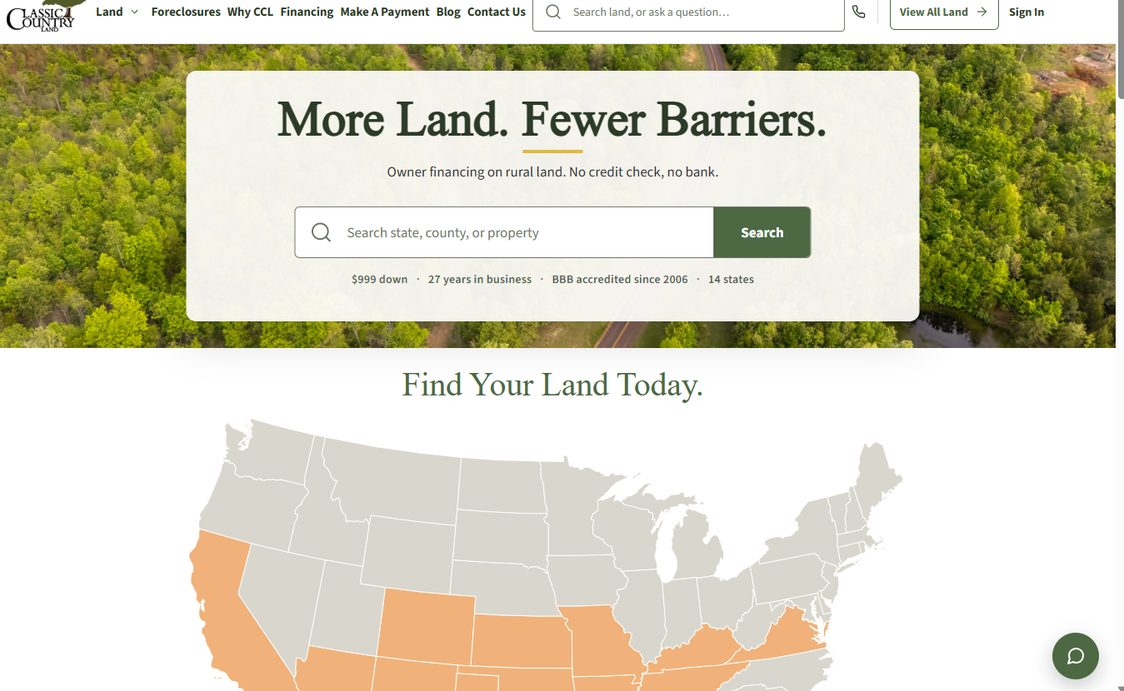
Classic Country Land specializes in rural land sales through owner financing, which is a game-changer for many. They remove the bank from the equation entirely, allowing for a much smoother path to ownership. This is perfect for those looking for timber, lakefront, or wooded properties in states like Oklahoma or Texas. By dealing directly with the property owner or a specialized land seller, you bypass the rigid underwriting algorithms used by big-box banks.
Because they utilize owner financing, the traditional hurdles of a bank loan often vanish. You can get started with a relatively low entry point, making it much easier to secure a piece of the countryside. This path is ideal for the “lifestyle buyer”—someone who wants to buy 5 or 10 acres to build a cabin later, rather than someone looking for immediate residential development. It is a rugged, straightforward way to build equity in the land itself through monthly installments.
Pros:
- No credit check or bank approval required.
- Low down payment starting at $999.
- Extensive inventory across 14 states.
Cons:
- Inventory is limited to specific rural locations.
3. Acorn Finance
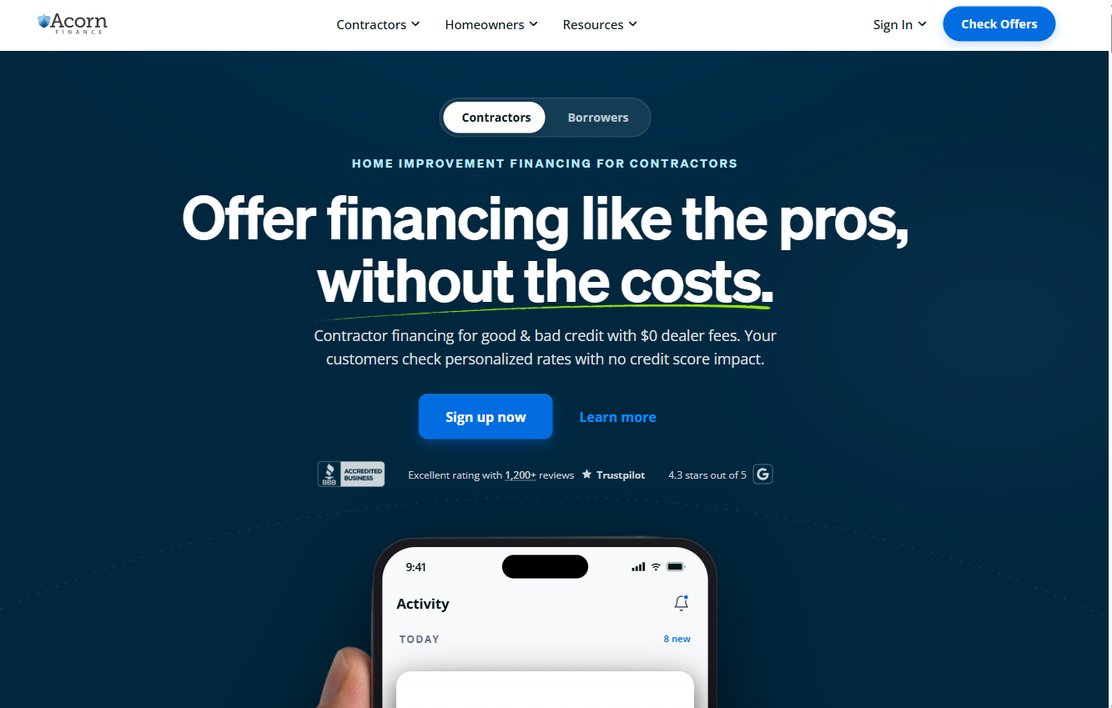
Acorn Finance operates as a specialized marketplace for home improvement and contractor financing. While it is heavily geared toward renovations, it serves borrowers with both good and bad credit. They focus on connecting people with professionals who can offer customized, transparent rates. If your goal is to buy land and immediately install a septic system, a fence, or a gravel driveway, this marketplace can connect you with the financing needed for those specific tasks.
The platform is designed to be completely free for the borrower, meaning no hidden dealer fees are passed down to you. This transparency is vital when you are already managing a tight budget for land acquisition. It is an excellent choice if your land purchase involves immediate site preparation or necessary infrastructure improvements. The speed of their offers is impressive for such a diverse range of projects, often providing a customized menu of options to choose from.
Pros:
- 100% free for borrowers with no dealer fees.
- Check personalized rates with no credit score impact.
- High customer trust with a 4.3-star rating.
Cons:
- Primarily focused on contractor-led financing projects.
4. LightStream
LightStream, a part of the Truist family, is a heavy hitter in the personal loan space. They offer financing for a wide variety of needs, providing a level of institutional stability that many boutique lenders lack. It is a professional option for those who need high-level financial products and are looking to use a personal loan to cover the down payment on a larger land purchase or to fund the initial setup of a small farm.
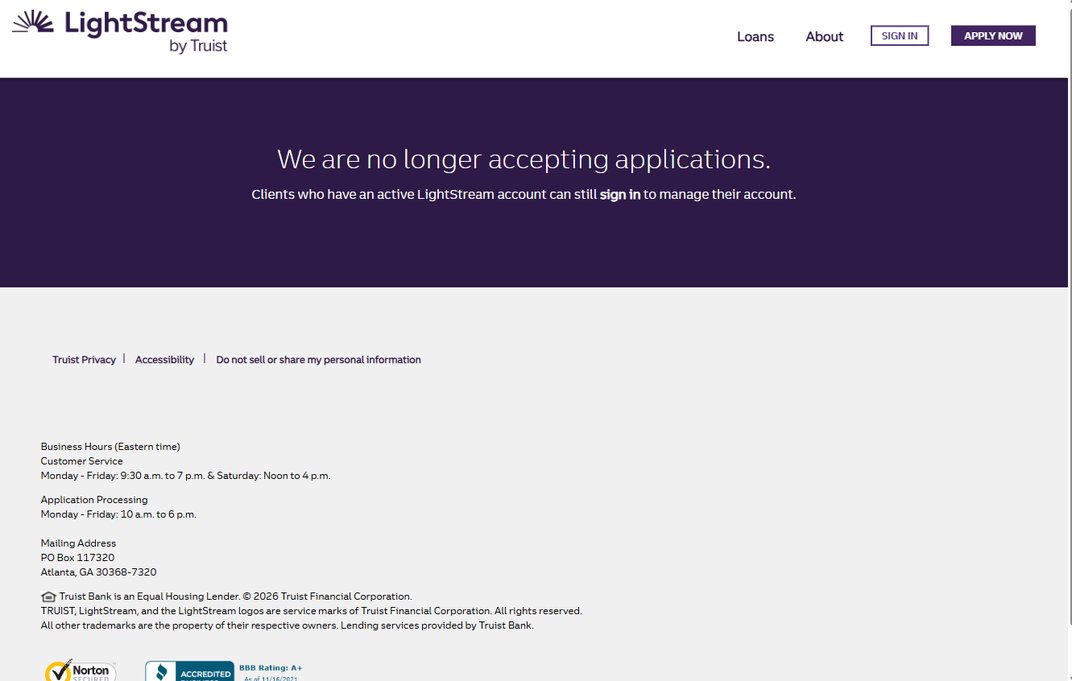
Because they are an established lender, their digital interface and customer service protocols are highly refined. However, it is important to note that their application window is subject to change, and they have recently stopped accepting new applications in some sectors. It remains a significant name to watch for anyone looking for specialized lending through a major financial institution, especially if you have a strong income but perhaps an unconventional asset structure.
Pros:
- Backed by a major financial institution (Truist).
- Versatile loan purposes for practically anything.
- Professional, established customer service.
Cons:
- Currently not accepting all types of new applications.
5. Country Bank
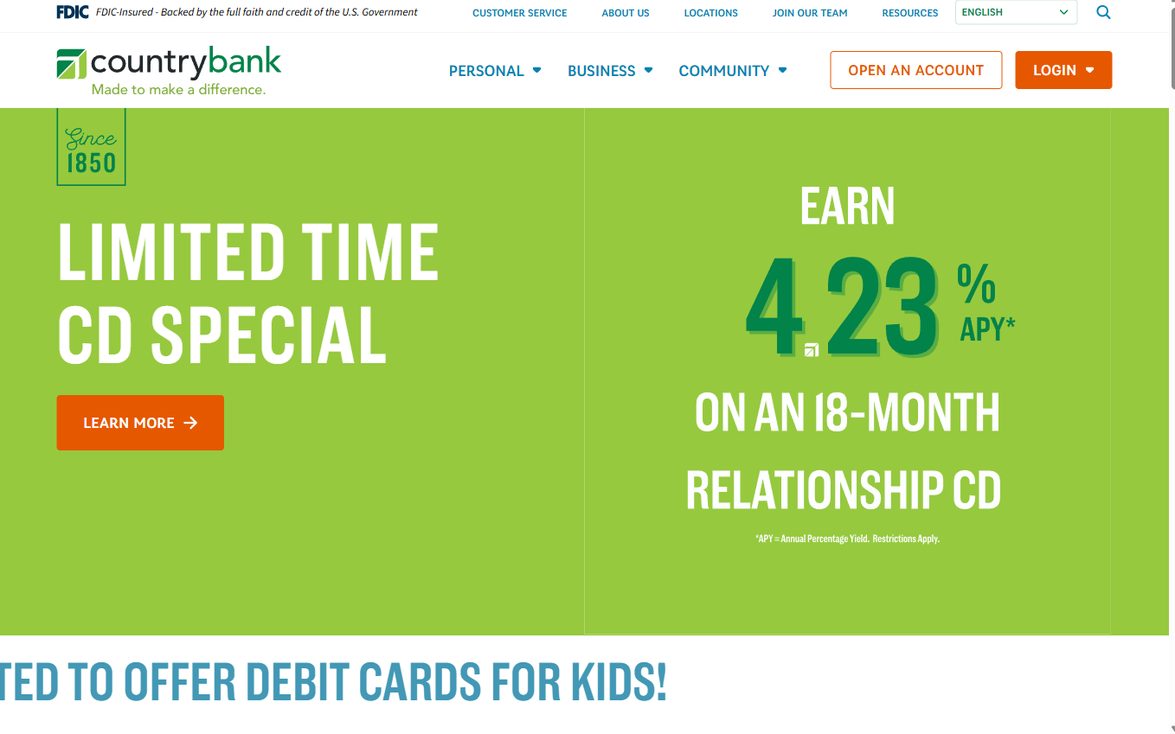
Country Bank provides a more traditional banking experience with a focus on community and personal needs. They offer a variety of products, including mortgages and personal loans, designed to fit a specific lifestyle. It is an approach focused on making a difference for local residents. Unlike a massive national bank that views every customer as a data point, a community-focused bank often looks at the person behind the application.
For those who prefer the security of an FDIC-insured institution, this is a reliable choice. They offer a range of products from checking to long-term loans, allowing for a holistic approach to managing your new land investment and your daily finances simultaneously. If you plan on building a home on your land in the future, establishing a relationship with a local bank now can make securing a construction-to-permanent mortgage much easier down the road.
Pros:
- FDIC-insured and backed by the U.S. Government.
- Comprehensive banking services from personal to business.
- Tailored products to fit specific budget needs.
Cons:
- Traditional banking requirements may be stricter than owner-financing.
Avoiding Pitfalls in Land Financing
One of the most common mistakes is underestimating the total cost of land ownership. Many people focus solely on the purchase price of the dirt but forget that raw land often requires significant investment for utilities, roads, and clearing. For example, bringing electricity to a remote lot can cost anywhere from $2,000 to $20,000 per pole, depending on the distance from the nearest transformer.
Always ensure your loan amount accounts for these “hidden” costs to avoid a sudden financial squeeze that could leave you owning land you cannot actually use. Another trap is failing to verify the specific type of land you are buying. Raw land, which has no utilities or access, often requires much higher down payments, sometimes as high as 50% to 70%.
If you enter a deal thinking you only need 10% down for a remote forest plot, you might find your funding falling through at the last second. Always request a “permissible use” report or check local zoning laws to ensure you can actually build what you intend to build on that specific parcel. Finally, pay close attention to the fine print regarding interest rates and prepayment penalties.
Some lenders might offer a low monthly payment, but if you cannot pay the loan off early, you could end up paying significantly more over time. This is particularly true with certain types of owner financing where the seller may include a “prepayment penalty” clause. Do your homework and compare the total cost of the loan, not just the monthly obligation.
Preparation Checklist for Land Loan Approval
Before you submit an application, take these proactive steps to increase your chances of success, regardless of your credit score:
- Verify Property Boundaries: Never finance land based solely on an old map. Ensure you have a recent survey to confirm exactly what acreage you are paying for.
- Check Access Rights: Ensure the land has “legal access.” If the property is landlocked and requires an easement through a neighbor’s property, many traditional lenders will reject the loan immediately.
- Gather Financial Proof: Even with owner financing, having proof of consistent income (pay stubs, tax returns) shows the seller you are a reliable borrower.
- Assess Soil and Drainage: If you plan to build a septic system, you will need a “perc test.” If the soil doesn’t pass a perc test, the land might be unbuildable, making it a poor investment for a loan.